
NC HEALTH NEWS - Cyclospora, a relatively unknown parasite, has been making headlines across the country as it’s given thousands of people an unpleasant case of explosive, watery diarrhea. In North Carolina, state leaders report there have been at least 307 cases of the infection.
North Carolina Health News reached out to several experts here in North Carolina to get more context about the foodborne disease: State Veterinarian Carl Williams and infectious disease physician David Wohl from UNC Health.
 As of July 20, the Centers for Disease Control and Prevention lists a total of 5,100 suspected cases of Cyclospora nationwide. The CDC’s update page reads: “This is substantially higher than the 249 cases reported nationally by this same time last year.” The CDC’s numbers are likely an undercount, however, given that in an update dated July 20, the Michigan Department of Health and Human Services reports 6,148 cases in that state alone.
No deaths have been reported related to the outbreak.
State Veterinarian Carl Williams told NC Health News that state health officials are updating case counts weekly.
(Note: These interviews have been edited for length and conversational flow.)
Carl Williams: We’re updating our case counts weekly, and our last update was 307 cases. But when we update our case count on Tuesday (July 21), it’ll go up from that.
NC Health News: At the end of last week, we heard that apparently this outbreak is being related to Taylor Farms lettuce. Do we think that is the only source, and the outbreak is related to the lettuce from that company?
Williams: What we suspect, based on previous years, is that there are multiple vehicles for Cyclospora beyond just the lettuce. And what we know is that the lettuce is what was implicated, especially in association with Taco Bell restaurants in the Midwest.
The large outbreak in Michigan, Ohio and a couple other states did implicate lettuce with a trace back to Taylor Farms, but that’s not what we’re seeing in North Carolina or the other states. We’re seeing that it seems to be associated with a large number of products, and it’s really hard to nail down a specific one.
Our best guess is that there’s probably multiple contaminated fresh fruits and vegetables that are contributing to this increase in cases that we’re seeing in North Carolina and across the country.
The U.S. Food and Drug Administration on Sunday withdrew its guidance about avoiding lettuce provided by Taylor Farms de Mexico, noting on its outbreak update website that, “Due to the complexity in detection of Cyclospora, FDA laboratory experts re-reviewed the sample results and have concluded that the finding does not represent true amplification and should be considered a false positive. Information about the sample has been removed from the July 18, 2026 update… As of July 19, 2026, there are no confirmed positive sample results for product testing for Cyclospora.”
NCHN: Tell us a little bit about Cyclospora. I understand that it can be challenging to diagnose and then a little bit challenging to treat.
Williams: It’s a parasite, and it’s resistant to chlorine, and it’s hard to get off of fresh fruits and vegetables.
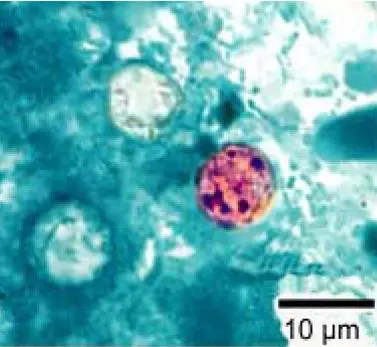
Humans are the only known reservoir for it. There’s no animal component. The only reservoir is people, but it’s not transmitted directly from person to person. Once the oocysts (spores) are shed in the feces, it takes up to a week for them to become infective. So it has to hang around in the environment and attach to a food product. It’s not going to be something like Shigella that’s directly transmissible from person to person.
What we’ve noticed in North Carolina and the United States is that it’s really a summertime phenomenon. We see almost all of our cases in June and July, with very few outside of that window.
NCHN: So this is, what, someone pooping in a field? And then somehow or another, the lettuce gets contaminated with that soil. Is that what you’re telling us?
Williams: It could be that. But in the past, outbreaks have been traced to surface water being contaminated with human feces, and then that water being used to either irrigate crops or to apply pesticides. So then, you can get, as opposed to just imagining an individual person having a bowel movement that might affect a very small area of a field. But if it’s being sprayed across the entire field for irrigation, that is how, or one way, that it could be placed on all of these fruits and vegetables.
The FDA has a lot of good information on their website for farmers and producers.
It’s very important where these fruits and vegetables are grown that the farmers adhere to good practices for septic systems, septic field placements, as well as using clean surface water for irrigation and pesticides and things like that, because these are all ways that the product could become contaminated at the source.
I think that’s an important distinction because restaurants [associated with the outbreak] aren’t really doing anything wrong. They’re getting product that’s contaminated, but they obviously don’t know it. You can’t see it, and unlike ground beef or chicken, which we cook to kill pathogens, there’s generally no “kill step” for fresh fruits and vegetables. Your tomatoes are served raw, they’re sliced up and put on the hamburger. The hamburger is safe because it’s been cooked, but the tomato, it’s not going to be cooked, right? Or the cilantro, or the parsley, or whatever it is.
That’s one of the reasons that it gets really tricky to figure out what specifically is associated with transmitting Cyclospora.
NCHN: When you have a bacterial outbreak, you can do DNA testing and maybe identify the source, but I understand that’s harder to do with Cyclospora. Why is that?
Williams: In North Carolina and in most states, we can do whole-genome sequencing for things like Shiga toxin producing E. coli or salmonella right at our state public health laboratory. But Cyclospora, because it’s a parasite, number one, it has a much larger genome, so there’s a lot more genetic material to go through and only the CDC does it. Everything needs to be shipped to the CDC, but they can do the molecular analysis and they can identify clusters for us based on genetically relatedness. It just takes longer.
What we’ve heard from the CDC is that this year, in particular, their lab is overwhelmed, and they’re probably going to implement some type of a strategy to prioritize cases for sequencing. But they’ve not specifically told us yet. All the states have a weekly call with them [on Mondays] so they might tell us more.
NCHN: Is it correct that the CDC stopped tracking Cyclospora last year?
Williams: It’s been reportable in North Carolina for years, and it’s been notifiable to the CDC. It’s still something we have always reported to the CDC.
The CDC website notes that reporting on Cyclospora by states became optional in 2025. Previously, reporting on Cyclospora had been required since 1997. Multiple media outlets reported last year that the federal agency has cut back on foodborne illness surveillance.
Reporting infections with Cyclospora is still required in North Carolina.
