
By: Jordan Meadows
Staff Writer
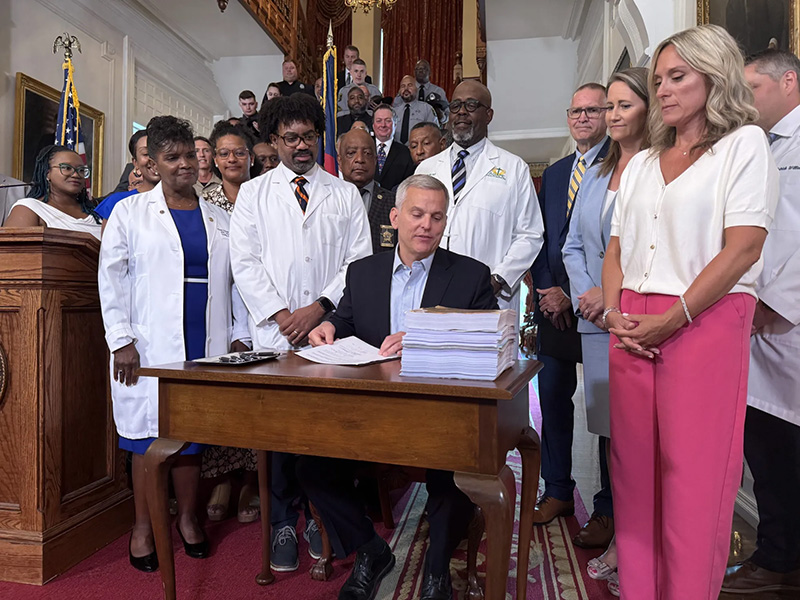
Gov. Josh Stein signed four bipartisan bills into law Monday at the Executive Mansion, capping the General Assembly's short session with legislation addressing gang violence, the state's involuntary commitment system, housing affordability and a sweeping overhaul of how North Carolina hires and retains state employees.
"Today I am proud to sign into law four bills," Stein said. "Each will make North Carolina stronger in different ways. They'll be making North Carolina safer, lowering housing costs and improving public services."
One moment of the signing ceremony came with Jaleeyah's Law, named after 13-year-old Jaleeyah Tune of Goldsboro, who was shot and killed in December 2025 in what lawmakers described as a random act of gang violence days before Christmas.
House Bill 1173 strengthens North Carolina's criminal gang laws by lowering the threshold for law enforcement to identify and charge someone as a gang member, more clearly defining what constitutes gang activity, and funding additional prosecutors and investigators for gang cases. The legislation marks some of the most significant changes to the state's gang laws since the Gang Suppression Act passed in 2008.
Stein also signed House Bill 1104, a broad revision of the state's involuntary commitment process that emerged from a separate set of tragedies. The bill follows Iryna's Law, a judicial reform package passed after the August 2025 killing of Iryna Zarutska, who was stabbed on a Charlotte commuter train by a man with a documented history of mental illness and prior criminal charges.
The earlier law required more suspects to receive psychiatric assessments in hospital emergency rooms, but hospital leaders objected, citing safety concerns for staff and patients. House Bill 1104 responds to those concerns by allowing psychiatric evaluations to be conducted in county jails through telehealth rather than in emergency departments. It also doubles the maximum length of court-ordered outpatient treatment from 90 days to 180 days, creates a new inpatient capacity-restoration program for defendants found incapable of proceeding to trial due to serious mental illness, and requires further studies on mobile crisis units and examiner training.
"We see far too often that mental health crises are funneled through the justice system instead of the mental health treatment system," said Health and Human Services Secretary Dev Sangvai.
Rep. Tim Reeder, a Republican from Pitt County and a physician who chaired the House Select Committee on Involuntary Commitment and Public Safety that developed the legislation, said the committee worked to balance public safety with the treatment needs of people in crisis.
"Too many individuals cycle repeatedly through emergency departments, jails, and treatment facilities without really getting consistent quality treatment," he said.
On housing, Stein signed House Bill 162, which prohibits most local governments from requiring developers to include a minimum number of off-street parking spaces in new construction. Supporters of the measure argued that mandatory parking minimums drive up construction costs and ultimately raise rents, with Stein citing estimates that such requirements can add between $200 and $300 per month to what residents pay.
The law also allows local governments to offer developers voluntary incentives for stormwater control measures that go beyond existing state requirements, a provision that drew support from both housing advocates and conservationists. North Carolina is projected to be more than 750,000 homes short of what it needs by 2029.
"We need to remove unnecessary and expensive barriers, like burdensome parking lot requirements that lead to higher housing costs," Stein said.
The fourth bill Stein signed, Senate Bill 1041, the Public Workforce Modernization Act, represents what Stein called the state's most comprehensive overhaul of its human resources system in roughly 50 years.
The legislation eliminates longstanding administrative rules that state officials described as too slow and rigid for a modern workforce, shifts hiring preferences away from college degree requirements in favor of skills, work experience, military service, and trade credentials, and streamlines the job application process. It also expands paid parental leave for state employees and teachers to 12 weeks for both mothers and fathers, up from the previous standard of eight weeks for mothers and four weeks for fathers.
"This legislation will help attract the next generation of state employees by creating new pathways in public service," said State Human Resources Director Staci Meyer. "Those include work-based learning like apprenticeships and skills-based hiring to bring in a wider pool of talent."
Stein also signed the state's first budget in two years on Tuesday afternoon, a $34 billion, 600-plus-page behemoth. The governor offered a mixed assessment of the legislation, praising several of its investments while arguing that the budget falls short of what North Carolina's public workforce and social safety net actually require.
On education, Stein pointed to teacher compensation as a significant step forward.
"This budget delivers the largest raise for teachers in nearly half a century," he said. "It is also the largest overall teacher raise in about 15 years."
He also highlighted the budget's Medicaid provisions, noting the program's reach across the state.
"More than a quarter of our state's population gets their healthcare through Medicaid," Stein said. "This includes children, pregnant and postpartum women, people with disabilities." He called the budget's treatment of the program "a big win for North Carolina."
But Stein was pointed in his criticisms of what the budget leaves unaddressed. Despite what he described as the largest correctional officer raise the state has seen in years, he noted that North Carolina remains among the bottom ten states in the country for correctional officer pay. Nurses, he said, will effectively make less in real dollars than they did two years ago once inflation is accounted for. The budget also includes no increases in unemployment benefits and fails to sustain NCWorks career centers, which help residents seeking employment navigate job training and placement services.
"The truth is, we here in North Carolina have a lot of catching up to do because there have been years of chronic underinvestment in state and public services," Stein said.
He also took direct aim at what he characterized as the General Assembly's continued prioritization of private school vouchers over public education, arguing that lawmakers are "continuing to pay wealthy people to send their children to unaccountable private schools while public schools have been chronically underfunded."
The budget, he added, maintains future tax cuts that he said disproportionately benefit shareholders and the wealthy, a choice he suggested comes at the direct expense of the public investments North Carolina most needs.
Fifteen bills remain on Stein's desk.
