
By Jheri Hardaway
Staff Writer
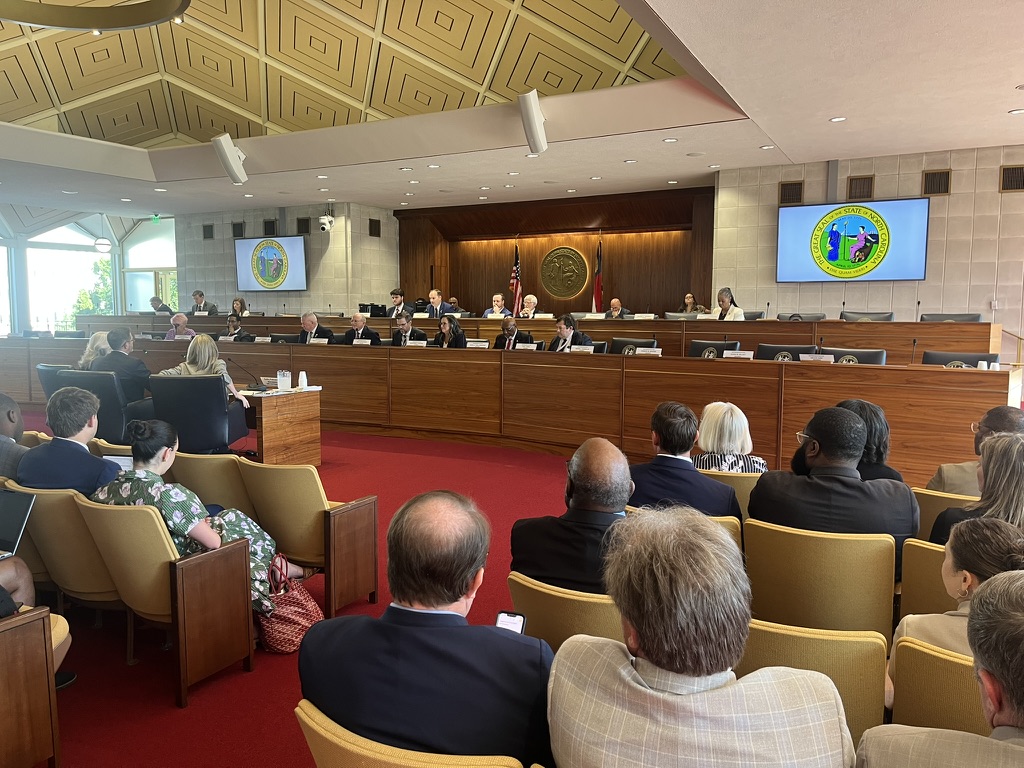
NC General Assembly - On Tuesday in an emotionally raw and highly technical committee session, the North Carolina House Judiciary Committee advanced a Proposed Committee Substitute (PCS) for House Bill 1144, also known as the Dominique Moody Safety Act. The updated bill, primary sponsored by Representatives Carla Cunningham (U-Mecklenburg), Allen Chesser (R-Nash), Mike Colvin (D-Cumberland), and Mike Schietzel (R-Wake), shifts from a broad outline to an enforceable, data-driven mandate aimed at removing legal immunity from bad actors and giving state supervisors the teeth to intervene in failing county systems.
The sweeping legislative update arrives on the heels of explosive legislative oversight hearings last Thursday that revealed devastating lapses by child protective services and local law enforcement in the lead-up to the horrific death of six-year-old Dominique Moody. The eight-and-a-half-hour hearing examined the tragic Dominique Moody case. Dominique was a six-year-old child who endured torture for the duration lifetime, ultimately weighing only 27 pounds at the time of her death. Throughout the hearing, discussions centered on systemic oversight and under-reporting. DHHS described the findings from a targeted investigation and a broader case file review as a "broad systemic lack of appropriate safety planning" that put children at unacceptable risk. There was a morning full of conversation around all the factors that went into the systemic failure that led to this child's death, the structural rot of the system: oversight failure, heavy caseloads, low wages. There was conversation about technology interventions to assist with oversight. One suggestion was to purchase a $73,000 software to improve upon the NC FAST system, but as someone who has worked with underserved youth I can say, all the oversight and tech in the world cannot beat a well-paid and supported worker doing an emotionally demanding and impactful job.
The testimony revealed that the failures in Mecklenburg County are occurring against a backdrop of broader systemic challenges plaguing North Carolina’s county-administered, state-supervised child welfare system. Yet this is not just a Mecklenburg County issue. The sad reality is that we see similar potentially fatal failures reflected in our current government at the county and state levels. The ongoing lack of a budget stands as a primary example of government inefficiency in North Carolina, which many are calling the most significant in our state's history. We are now witnessing the tangible impacts of this budgetary vacuum: occupational health providers are struggling to keep their staff, businesses are delaying opening to the area due to a lack of planned infrastructure held up by the missing budget, and state employee compensation remains stagnant.
This is a frustrating parallel to the state and local leadership failures Dominique Moody faced; both the Department of Health and Human Services and law enforcement were present, yet ultimately ineffective. Over 58 calls to 911, yet no protective action for the child; During the 2025–2026 session of the North Carolina General Assembly, roughly 1,150 House bills and 1,100 Senate bills have been filed yet no state budget. Similarly, we have a state legislature led by a party that has proven to be uncollaborative internally. The inability to advance key legislation unless it serves a partisan agenda, rather than the collective good is telling. Private school vouchers and systemic neglect have led North Carolina to lose strong teachers, social workers, and other critical professionals, which in the coming years will leave us in a serious bind. These are dark times for both America and North Carolina, and the irony of these failures occurring during our 250th anniversary is not lost on this author. Dominique Moody deserved better and so do the people of North Carolina.
Upon leaving the Tuesday, June 9th House Judiciary Two hearing, I overheard a prominent Republican Senator from a top tourism county say to his colleagues in the open hallway, “The prisons are open and we’ve got to fill them up.” This brought my mind back to Dominique Moody bound in her cage leading me to wrestle with the thought that leaders of the party controlling our state legislature want to see the people locked in cages for their personal profits as well.
