
WUNC - Michael Wilkerson uses a flip phone.
That may not immediately strike anyone as strange until they find out that Wilkerson is a junior at UNC-Chapel Hill. He got his first phone in middle school, and it wasn't until his first year in college that he realized: "I hate my phone."
"My phone died one day, and I still went out and hung out with my friends," he said. "I realized that life went on, you know? I didn't need it."
Wilkerson isn't alone. A 2024 study by Pew Research Center found 95% of teens have access to a smartphone. About 4 in 10 teens said they spent too much time on their phones or social media. Roughly the same number reported having taken steps to reduce their screen time.
Social media is rife with content about teens and young adults embracing physical media. Take the Triangle's own Angeline Richard, who has amassed over 46,700 TikTok followers by posting content on nostalgia and physical media.
She said she's seen the prices for nostalgic physical media jump in recent months, as internet trends ironically encourage people to get off their phones and off of streaming services.
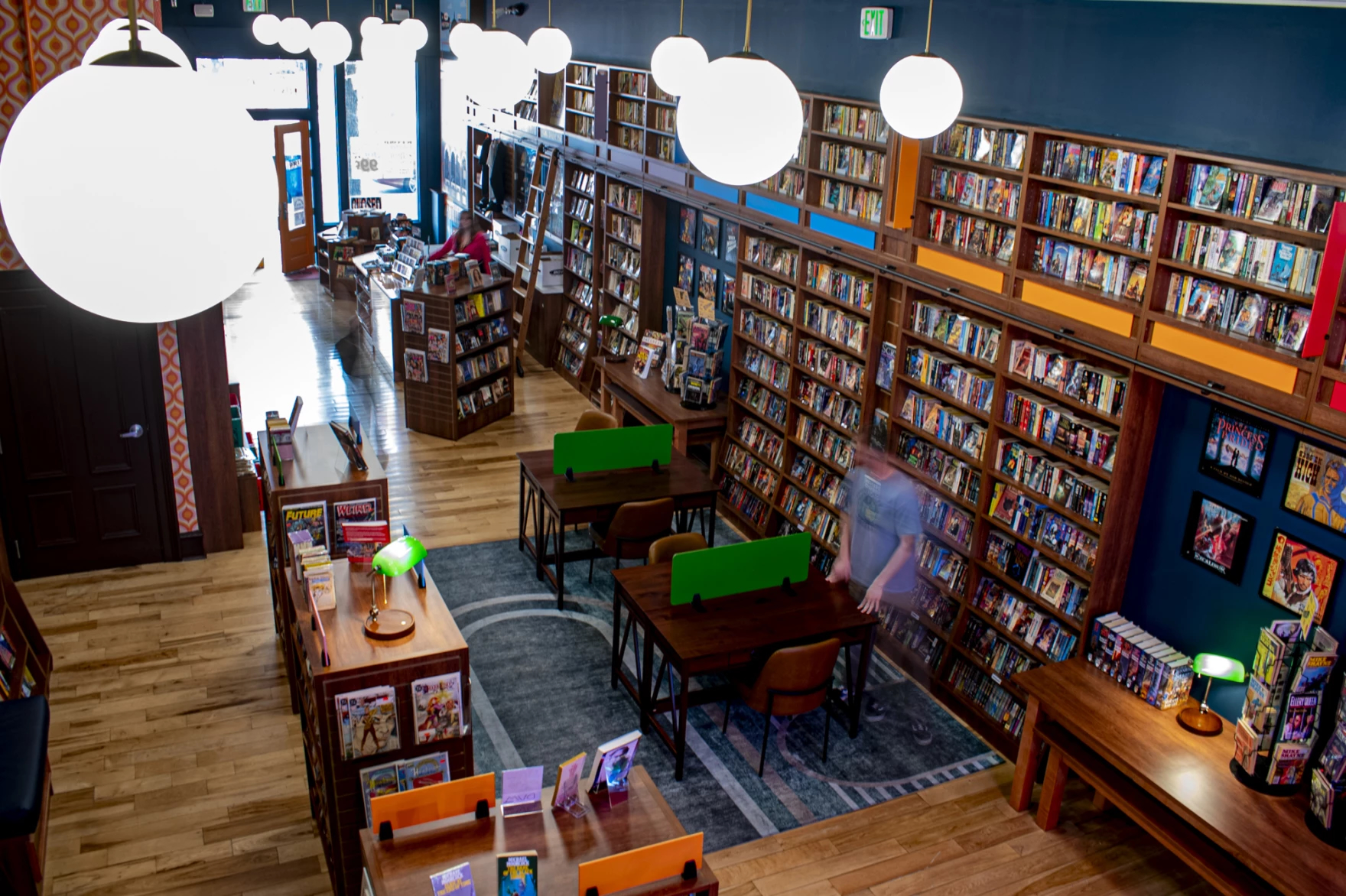
Then there's The Newsagent's in downtown Raleigh, a newly opened vintage media store whose co-owner, Neetzan Zimmerman, has a background as a digital journalist. He's hoping to curate a space where people will engage with media outside of algorithms and media companies.
There's certainly still an audience for the vintage market: Vinyl sales are on a 19-year growth streak, according to a 2025 report published by the Recording Industry Association of America. Physical media sales still account for 12% of total US revenue.
So, what's going on with physical media? We sat down with Wilkerson, Richard and Zimmerman to learn more about their stories and what attracts them to analog.
'I'm more connected out in the world.'
Wilkerson had tried a few different ways to get off his phone. One day, as a first-year student, he challenged himself to take the bus from Chapel Hill to Raleigh without using his phone. He also tried leaving his phone in his room to hang out with friends.
But no matter how he tried to get off of social media throughout college, he said, he was unsuccessful.
"It was just so easy, so easy to be like, 'Oh, I wonder what happened on Instagram tonight,' and then just re-download it and scroll, and five minutes, and then 30 minutes have gone by," Wilkerson said.
What changed for Wilkerson was the passing of his father the summer after his first year at UNC. His mother had died in eighth grade, and losing another parent changed who he was, Wilkerson said.
His father had always been a fan of physical maps, a quality he passed on to Wilkerson. In the wake of his passing, Wilkerson said he wanted to be more independent and more connected to the world around him.
"Whenever I get rid of my phone, I feel like I'm more connected out in the world," he said. "There's smaller things that you realize."
At the start of March, Wilkerson decided to purchase a Jitterbug flip. The phone has everything he needs, he said. It's got a clock, calculator, camera, and even an FM radio that he can listen to with wired headphones.
He gave his phone to his girlfriend, who goes to Meredith College, and went completely without a smartphone for a month. The biggest change he noticed during his time away was that he was able to focus more on school and friends, he said.
Smartphones don't always mean addiction, Wilkerson said. Some people can just control their screen time.
"But I then think that there are some people who have never lived without an iPhone, so you kind of don't know how much you're relying on it for," he said.
While he's not switching permanently, Wilkerson said he wants to figure out a way to integrate his flip phone into his life after the experiment. He's already done the same with lots of other physical media, including his film camera, his Walkman, and his MP3 player.
He even uses business cards to give his number out to new friends.
Wilkerson said his advice to people interested in switching to a physical media-based lifestyle is simple: Start by leaving your phone in your room.
'Is this why everybody's so mad? Because we just lack color?'
Though Angeline Richard had kept some of her most meaningful VHS tapes and DVDs from when she was younger, her progression towards physical media really began in the fall of 2023.
Richard said she grew frustrated with streaming services, tired of the non-stop ads, changes to her subscriptions, and on top of it all, her favorite media disappearing. Around that same time, she realized many of her favorite movies and TV shows were in thrift stores for only a few dollars.
"I was like, I'm paying $12 a month for one subscription, and then $10 for another one, and then, like, $5 for another one, and then a free trial for another," Richard said. "I'm looking for all these movies on different platforms when I could just go to the thrift store."
She began to collect media, and after graduating from North Carolina Central University in 2024, began to post about her physical media collection, specifically highlighting early 2000s tech and nostalgia.
Now, living in Princeton, N.C., Richard is a full-time content creator with almost 70,000 followers on Instagram and TikTok.
As of February, her physical media collection totaled 101 VHS tapes, 203 DVDs, 91 books and 24 CDs. She uses an iPod shuffle for music, a DVD player and VCR to watch content and consoles for gaming.
Richard said she saves $50 to $70 a month by owning her own media. She's only subscribed to Netflix to watch one of her favorite shows, "Bridgerton."
When she first started sharing her physical media collection, Richard said there weren't that many people creating similar content. She's noticed more online engagement around physical media, especially starting in the summer of 2025. People are connected to the sentimental stories behind physical media, she said.
Reconnecting with older content has reminded her how unique different art styles and illustrations can be, Richard said. She said she's noticed she has more color in her life, especially since modern media can look dull.
"It just made me think, 'Wow, is this why everybody's so mad?'" she said. "Because we just lack color?"
The biggest lesson people can take away from physical media is slowing down, Richard said, and taking the time to actually learn more about their interests and styles.
"Overconsumption has been so bad, especially when it comes to trends, people want to buy everything to be part of it," she said. "Everybody just wants to be part of something. That's just human nature."
'Who controls the access?'
Right off of Fayetteville Street sits one of Raleigh's newest stores: The Newsagent's. Tucked inside its bright orange door sits a world of vintage physical media, coffee and nostalgia.
Husband-and-wife duo Neetzan Zimmerman and Yulia Shamis opened the store this spring with a unique goal: Helping people rediscover, preserve, and restore physical culture outside of digital algorithms.
Zimmerman's relationship with physical media traces back to his childhood, growing up in a remote socialist commune in Israel with no personal possessions. The only way he could really "access culture" was through a VHS player purchased by his dad. His grandmother would send him VHS tapes of popular shows, like The Simpsons.
Zimmerman said his love for physical media comes from both having difficulty accessing it and from growing to love the labor it takes to preserve it.
In the age of streaming, access is not guaranteed, Zimmerman said, because streaming giants get to decide what content audiences can access through rights and deals.
Many media corporations have no incentive to create physical manifestations of their content, he said, meaning there are fewer and fewer distribution channels for film and music. Then there are the pieces of media that never transferred to the digital realm at all.
"It's all about who has access, who's allowed to have access, who controls the access," he said.
Previously, Zimmerman was an online, digital content creator and journalist. His website, The Daily What, was acquired by early internet humor giant Cheezburger in 2010, and he worked in senior positions for websites like Gawker, The Messenger, and The Hill.
After a few years working as a digital consultant, he tried to make his way back to media, but found the ship had sailed.
Zimmerman said he was looking for something that contributed more positively to the world. He was especially discouraged by the removal of media online, and the amount of "manipulation" occurring from bots and outside actors online.
"There's kind of a cycle of toxicity that just kind of naturally occurs where well-meaning people are sort of corralled in a space with many bad faith actors," he said. "And not even just like bad faith people, but more just like actors of an unknown agenda."
He's grown concerned about people's inability to retain information, especially about content they've spent hours scrolling and consuming. Though Zimmerman said it's not realistic to get off of your phone completely, it is important to set up an alternative to the digital world.
That's part of the inspiration behind The Newsagent's, which encourages customers to sit in the store outside of just shopping.
Zimmerman said he appreciates the intentionality that comes with physical media, and he wants people to spend time letting new ideas and genres marinate.
"Everyone's going to need a break from whatever it is, and we do live in interesting times, and maybe a break is more necessary than in the past," Zimmerman said. "This kind of place hopefully provides that break."
