
By Jheri Hardaway
Staff Writer
North Carolina General Assembly - In a monumental 6-3 decision that has sent shockwaves through the American South, the U.S. Supreme Court has effectively dismantled key protections of the landmark Voting Rights Act (VRA). The ruling, which centers on the case Louisiana v. Callais, upends decades of precedent and makes it significantly harder for minority voters to challenge racially discriminatory voting maps and laws. The court’s conservative majority ruled that race-neutral partisanship can be used as a valid defense for redistricting, even when it results in the dilution of minority voting power. The decision has left civil rights advocates and North Carolina legislators reeling, with many warning that the state is entering a new era of "Jim Crow-style" electoral barriers.
North Carolina State Representative Phil Rubin (D-Wake), a former federal prosecutor and constitutional law expert, did not mince words regarding the court’s intervention. "I'm really scared for our future when you have a Supreme Court that thinks it knows better than the Congress of the United States that enacted the Voting Rights Act," Rubin said. "Congress enacted the VRA because of its determination about unconstitutional and awful barriers to voting for minority communities. To have a Supreme Court come and chip away at it and basically say, 'We know better,' is dangerous."
Rubin took particular aim at Chief Justice John Roberts, suggesting that the "balls and strikes" judicial philosophy Roberts famously championed during his confirmation is a thing of the past." The opinion is obviously a travesty. It's not the law. It is power," Rubin stated. "And I hate to see that. But I also know that in the long run... we're going to win and we're going to see it through to fix it."
Representative Garland Pierce (D-Hoke/Scotland), one of the longest-serving members of the General Assembly and a lifelong minister, described the ruling as a "heartbreaking" reversal of progress. "It’s taken us back. And folks say way back to, you know, Jim Crow and all of that," Pierce said. "The Supreme Court is a gang of six that made a decision that's going to affect us going forward. It’s heartbreaking, heart-wrenching, because you have older people who remember when it was like that, and now they're like, 'What? We're there again?"
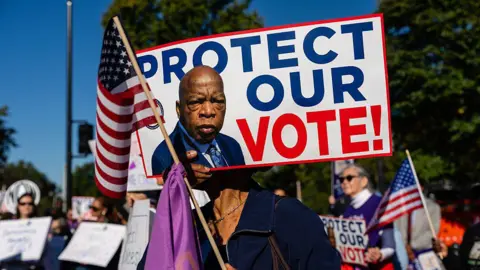
Pierce noted that the immediate fallout is expected to affect at least 20 minority members of state and federal bodies across the South as states move to redistrict under the new, more lenient guidelines. While the legal setback is severe, North Carolina lawmakers are urging their constituents not to succumb to "disenchantment." Pierce emphasized that the primary tool remaining for the public to fight back is the vote itself. "Elections have consequences. The reason why we're dealing with now is that people did not go vote," Pierce warned. “You have to continue to battle and fight."
Despite the "challenging and difficult" days ahead, both Representatives Rubin and Pierce expressed eternal optimism. As the state prepares for its next cycle of redistricting battles, the message from Raleigh is clear: the fight for the ballot is no longer just in the courts, it is in the hands of the voters.
