
Dana Hunsinger Benbow
Indianapolis Star
In football, they're called unicorns — those extraordinary players who have a toolbox of skills that make them not only versatile on the field, but a rare phenomenon to witness. Football unicorns make people stop and stare in wonder, incredulous at the feat they just saw them perform.
Jaylon Smith was a football unicorn.
 An Indiana native, Smith won four state championships at Fort Wayne's Bishop Luers High School and the title of Indiana Mr. Football. At Notre Dame, he was an elite, generational linebacker, widely considered one of the best in school history. Smith won the 2015 Butkus Award as the nation's top linebacker and was a 2014 Second Team All-American.
As the 2016 NFL Draft approached, Smith was projected, almost universally, to be a top-five pick.
That was before his foot got caught up in the turf during the first quarter of the last game of his college career at the Fiesta Bowl in January 2016. That was before an Ohio State player pushed him after a fumble, causing Smith to land on his left knee, which bent in a way that defied human anatomy.
Smith suffered severe injuries, a torn ACL and a torn LCL/MCL.
His NFL stock plummeted.
The Dallas Cowboys took Smith 34th overall in the second round of the NFL Draft, with $4.4 million guaranteed. A top five pick would have secured $23 million to $28 million in a four-year rookie deal at the time, according to Forbes.
"That (injury) cost him $18 million coming out," says Michael V. Ledo, a longtime mentor and financial advisor to Smith.
Yet, in what defied all injury odds, Smith went on to have a successful NFL career, despite nerve damage that some said meant he would never play again.
Smith was a 2019 Pro Bowler who played 88 NFL games, primarily with Dallas from 2017 to 2021. He was a tackling machine, recording three consecutive seasons with more than 100. In his career, he had 626 tackles, 11 sacks and six forced fumbles.
But what most didn't know about Smith, as he was deeply embedded in his NFL playing days, was that he was quietly learning and toiling over the inner workings of investing, off the field. And Smith wasn't just a student, he was making his own financial moves.
Which leads to Smith, not just a football unicorn, but a unicorn investor. During his final season with Dallas in 2021, Smith put $100,000 into Oura Ring, a smart ring that tracks health, wellness, sleep and fitness.
"I was very passionate about the health and wellness space, especially around COVID," Smith says. "That's something that really intrigued me. And I invested right away. And I was a believer."
Oura is now one of the most recognized performance and health-tech platforms in the world, "and that position just delivered nearly a 10x return and a 56% IRR at an $11B valuation," according to a report from Rise Family Office, which was founded by Ledo, who is also the CEO.
What that means for Smith, in layman's terms, is that the $100,000 he invested in 2021 turned into $1 million in 2026. He recently exited Oura, taking his earnings with him.
"In the investment world, a unicorn is anytime you've got a company that's went to a billion dollar valuation or they've had a 10x on your money," Ledo says. "Jay put a hundred thousand, and he made a million in five years, which is crazy. That's not normal."
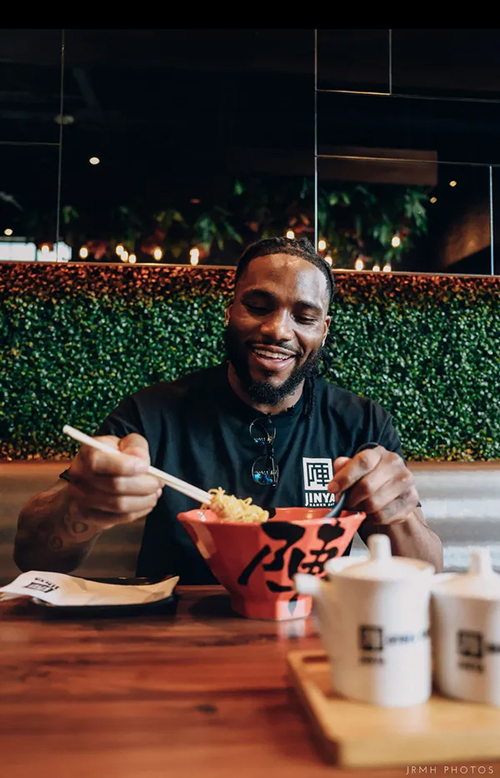
Smith is putting that money into his Jinya Ramen Bar locations. He has the rights to Indiana, with eight to 10 restaurants planned, as well as locations in Illinois. His first bar opened in July 2025 on the Notre Dame campus, and was recently voted the best restaurant in South Bend.
Beyond ramen, Smith has many other investments, 21 to be exact. He has been steadily building a portfolio spanning Sam’s Club eyewear distribution, real estate, franchise ownership, his insurance agency and more.
"And that is why he'll never go cash poor, because he's not trying to live on what he did for 10 years in the league to last forever," Ledo says. "His kids are going to be able to hear about him playing football but be proud of seeing the kind of father and leader he is day to day, just not living on his past."
First, there was Burger King
By the time Smith was 11, he wanted to be an entrepreneur. He may not have known exactly what that meant but he knew he wanted to one day own some kind of cool business and make a lot of money off of it.
He also wanted to be an elite athlete.
When Smith was 14, he found someone who would be a mentor to him in both realms. At the time, Ledo ran an athletic training company in Fort Wayne called AWP, Athletes with Purpose. Hundreds of kids came through the program, 200 went to college, 100 to Division I, 15 to the NFL, and Smith was the best of all of them, Ledo says.
Soon, Ledo wasn't just talking to Smith about football. He was talking to him about life and everything it would take to be successful, including finances.
"He really taught me the essence or the importance of thinking at a very young age," Smith says, "thinking beyond the game and searching to find my purpose beyond athletics."
The winter of his senior year of high school, after winning his fourth state championship in football, Smith opted out of playing basketball for his final season and took a job at Burger King. He wanted to get a taste of what it was like to work in the real world, outside of sports.
