
By Jordan Meadows
Staff Writer
In the late 18th century, Henry Evans, a free Black cobbler and Methodist preacher from Virginia, became one of the most influential religious figures in early Fayetteville.
Born around 1760 to free parents, Evans arrived in Fayetteville around 1780 while traveling to Charleston, South Carolina. Struck by the spiritual needs of the local Black community—many of whom were enslaved—he chose to remain in the town.
Evans’s early ministry was met with resistance: town authorities attempted to suppress his preaching, forcing him to hold services in secret and in remote areas of the surrounding sand-hills to avoid harassment and violence. Despite these obstacles, his message gained a devoted following. Over time, even white residents began to take notice of what they saw as positive changes in those who attended his services.
As his influence grew, opposition softened, and Evans was eventually permitted to preach openly within the town. By the turn of the 19th century, a modest structure had been built to house his congregation, marking the establishment of what is widely considered the first church within Fayetteville’s town limits. Black worshippers filled the main space, while white attendees occupied designated seating areas—though these distinctions increasingly blurred as attendance surged. Additional sheds were later constructed to accommodate the growing number of worshippers, including prominent visitors who sought out Evans’s sermons.
Methodist Bishop Francis Asbury, who visited the church several times, referred to it as the “African meeting house” in his journal, underscoring its significance.
Evans was described by contemporaries as deeply knowledgeable in scripture and committed to his ministry under difficult circumstances. According to later accounts, he risked his life multiple times to continue preaching, including dangerous crossings of the Cape Fear River.
Bishop William Capers, who encountered Evans near the end of his life, later called him “the father of the Methodist Church, white and Black, in Fayetteville, and the best preacher of his time in that quarter.”
After declining health forced Evans to step back from active preaching around 1806, he remained closely tied to the church. He lived in a small room behind the pulpit, continuing to serve as a spiritual presence until his death in September 1810.
In his will, he ensured that the church would continue after him, while also providing for his widow, who was allowed to remain in their living quarters for the rest of her life.
In Evans’s final appearance before his congregation, frail and near death, he delivered a farewell message emphasizing faith and perseverance by recalling the dangers he had faced in bringing the gospel to his community. His funeral drew one of the largest gatherings Fayetteville had seen at the time.
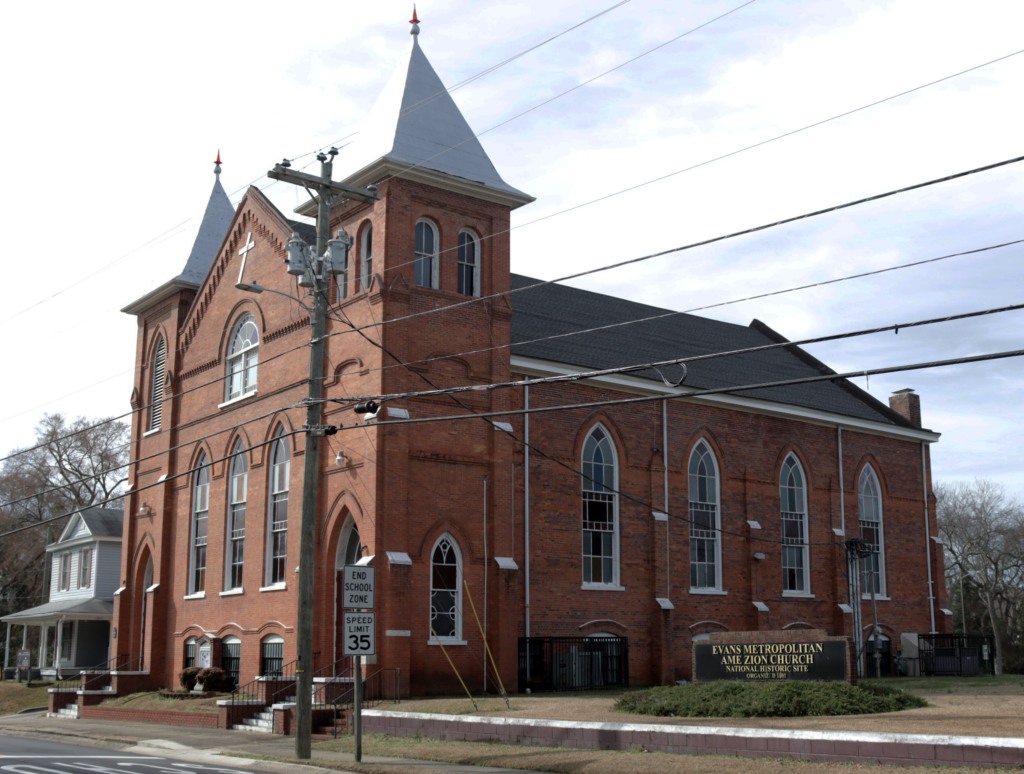
He was initially buried beneath the church. His remains were later moved to the grounds of Evans Metropolitan A.M.E. Zion Church, which now stands near the original site.
