
 By Jheri Hardaway
Staff Writer
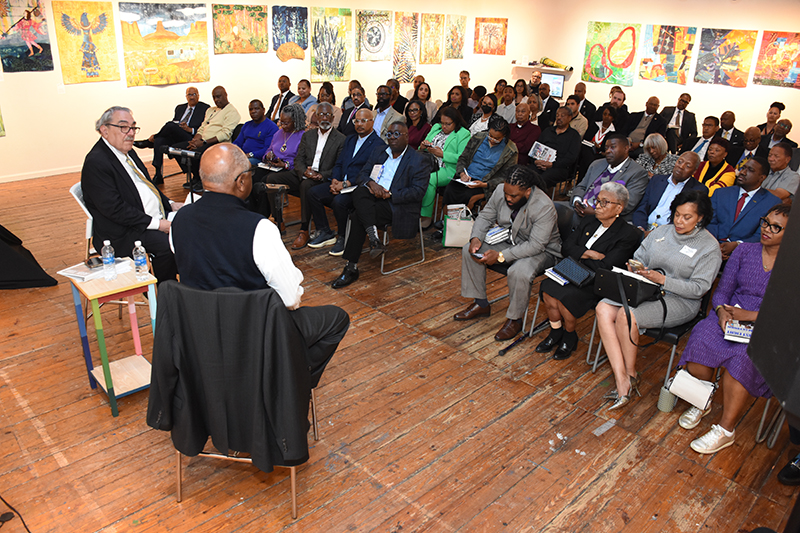
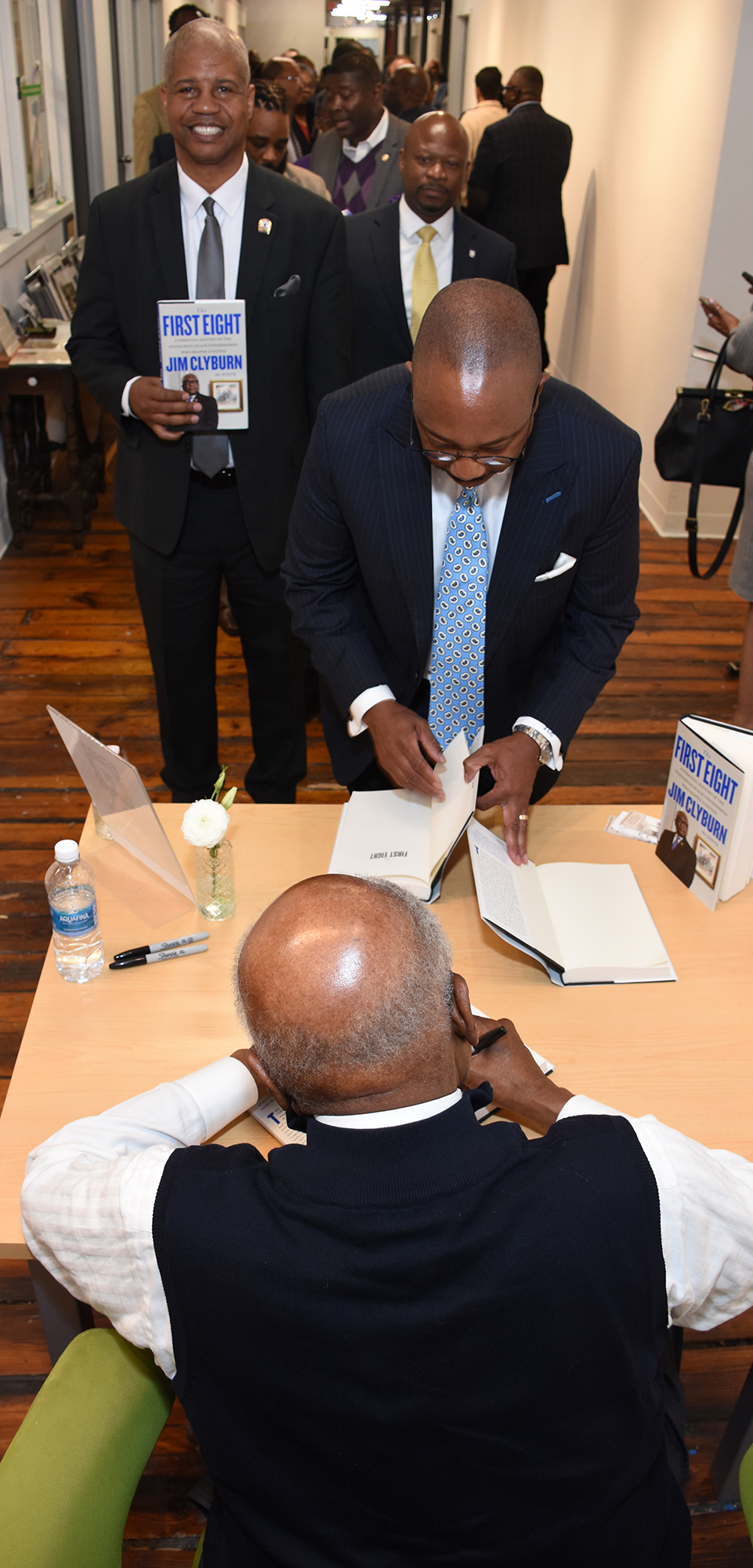
Monday night at Artspace in Raleigh, a palpable sense of history filled the air as Congressman Jim Clyburn (D-SC) took the stage to discuss his latest book, “The First Eight,” with a packed audience that included dignitaries and local leaders. The event began with a warm welcome from former Congresswoman Eva Clayton. Clyburn's message was not merely a historical recap, but a poignant and urgent warning about the current political landscape, drawing direct parallels between the post-Civil War Reconstruction era and today's challenges to voting rights.
He began by emphasizing the deep historical significance of North Carolina, particularly in Raleigh, noting that thirteen African American men had convened in 1865 for the State’s Constitutional Convention, following an initial conviction at their home church St. Paul AME Church. He singled out Bishop James Walker Hood as a “luminary participant” in this convention, highlighting Hood’s mission to establish the AME Zion church in North Carolina and his work with the Masons.
 Clyburn then linked this historical moment to the broader national context, specifically the 15th Amendment, which became part of the Federal Constitution on March 30, 1870—exactly 156 years prior to his speaking yesterday. He noted that eight months later, South Carolina led the way by electing African American men to Congress, emphasizing the power of the newly secured right to vote. This historical groundwork set the stage for the core thesis of his talk and his book: the enduring importance of understanding and actively participating in the political process to safeguard hard-won rights.
Clyburn’s speech was less a typical book talk and more a compelling historical narrative with profound contemporary relevance. He argued that the pivotal moments in African American history following the Civil War—the 13th Amendment freeing the enslaved, the 14th guaranteeing due process and equal protection, and the 15th securing the vote—were met with fierce resistance, culminating in the assassination of Abraham Lincoln when he began to advocate for the right to vote for former slaves. Congressmen Clyburn asserted that it was the right for the negro vote that pushed John Wilkes Booth to take the life of President Lincoln.
He further illustrated the fragility of progress by highlighting how single votes shaped critical events during Reconstruction. Andrew Johnson’s acquittal during his impeachment trial, which preserved his presidency and allowed him to undermine Reconstruction efforts, hinged on a single vote. Similarly, the 1876 presidential election between Samuel Tilden and Rutherford B. Hayes was decided by a 15-person commission by a narrow 8-7 vote. This decision, which awarded the disputed 20 electoral votes to Hayes, led to the "Compromise of 1877" and the subsequent withdrawal of federal troops from the South, effectively ending Reconstruction and ushering in the oppressive Jim Crow era.
The most potent part of Clyburn's address came when he connected these historical events to the present day. He explicitly referenced pages 175 and 176 of his book, which describe the emergence of "creative devices" designed to disenfranchise Black voters after the end of Reconstruction. He forcefully argued that the contemporary debate over legislation like the "Save Act" is a direct prologue to this dark chapter, with current efforts to restrict voting echoing those from over a century ago. “If I were to rename it or put a timestamp on this book today, the subtitle would be different,” Clyburn said. “It would be 'The First Eight, whose lives and experiences shaped the nation and serve as a foretelling of today’s political condition.' We have to learn from this history, or we are bound to repeat it.”
He provided concrete statistics to underscore his point, noting that in 1880, South Carolina had approximately 91,000 votes cast by Black people. Ten years later, that number plummeted to around 13,000. He also pointed out that in 1880, South Carolina’s state legislature had 93 members, while in the 20 years following, that number dropped to zero. He warned that if legislation like the "Save Act" becomes law, the number of current members of the Legislative Black Caucus could dwindle rapidly, similar to the historical precedent following the end of Reconstruction. He noted that following the Supreme Court’s ruling in Shelby County v. Holder, which gutted Section 4 of the Voting Rights Act, 30 states immediately changed their election laws to make it harder to register and vote, with North Carolina and South Carolina being among them with Voter ID laws.
When asked if history is repeating itself, Clyburn responded with a definitive "Yes," but added an important caveat: “Just because history repeats itself doesn’t mean the result will be the same. That’s why I wrote this stuff, for you to understand the dynamics…so we can build defenses.”
He emphasized that progress is only achieved through active participation, not just marching or protesting. Drawing an analogy to atomic energy, he argued that just as the energy from an atom is only useful when harnessed, the "energy" created by marches and protests is only effective when channeled into a "targeted" vote. He linked this to his own experiences, stating that while he spent time in jail marching, the time that really matters is "marching into that booth" to cast a vote.
Clyburn’s message was a clear call to action, urging the audience to remain vigilant, to learn from history, and to prioritize voting above all else. His speech served as a powerful reminder that progress is not guaranteed and that the struggle for equality and democratic representation is an ongoing generational battle. As he concluded, he left the audience with a stark warning: ignore these lessons at the nation’s peril, as the forces that sought to disenfranchise and oppress are still very much present and active today.
