
By Jordan Meadows
Staff Writer
A growing national debate over immigration detention has found a focal point in eastern North Carolina, where federal officials and private prison operators are exploring new sites for expanded Immigration and Customs Enforcement (ICE) facilities.
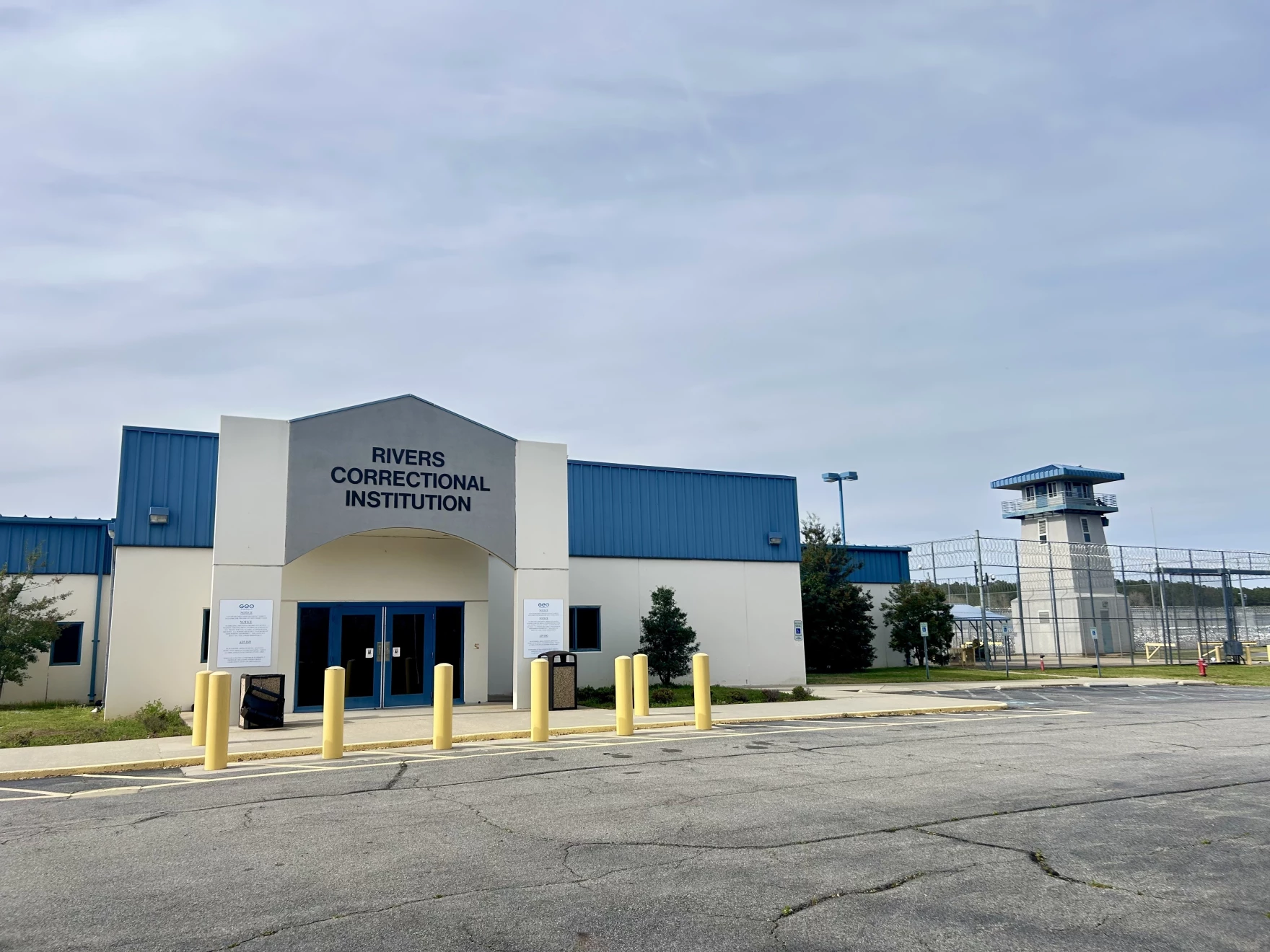
The long-shuttered Rivers Correctional Institution in Hertford County, a 257-acre private prison complex, could soon be repurposed into a detention center for immigrants awaiting deportation. The facility, owned by The GEO Group, closed in 2021 after the Biden administration ended federal contracts with private prisons, citing dangerous conditions that included violence, contraband, and reports of inmate sexual abuse.
Newly released documents obtained by the American Civil Liberties Union through a Freedom of Information Act request indicate that the company is in negotiations with ICE to reopen the site as a roughly 1,300-bed detention center, part of a broader federal effort to expand immigration detention capacity nationwide.
That expansion effort is backed by significant federal investment, including $45 billion approved by Congress last year to scale up detention infrastructure. As a result, North Carolina has emerged as a key target, with multiple cities and rural communities under consideration for new or expanded ICE operations.
In Hertford County, the proposal has drawn both support and opposition. The closure of Rivers in 2021 resulted in approximately 300 job losses in a region grappling with population decline, and some local officials and residents have expressed interest in reopening the facility to restore employment opportunities.
Those concerns have sparked an unusual wave of public protest in the small town of Ahoskie. Dozens of residents recently gathered at the intersection of First and Academy Streets. The protest, organized in part by local advocacy groups such as The Cultivator, reflects a broader grassroots campaign aimed at preventing the facility’s reopening. Nearby residents, including those from Murfreesboro, have voiced similar objections.
The history of the Rivers facility adds another layer of complexity to the debate. Built on land that was once a cotton plantation belonging to the Meherrin Indian Tribe, the site still contains antebellum-era graves of the Vann family, a legacy that researchers say symbolically ties past systems of exploitation to present-day incarceration practices. The prison previously operated as a Criminal Alien Requirement facility, housing noncitizens serving federal sentences, and its potential transformation into an ICE detention center would mark a continuation of that role under a different legal framework.
In Greensboro, ACLU documents identified the city as a potential site for another detention center. The proposal, submitted by the private firm The Baptiste Group, would convert the former American Hebrew Academy, a 100-acre boarding school campus, into a large-scale detention facility.
In response, city leaders amended zoning regulations to impose stricter requirements on detention facilities, including a mandate that such sites be located at least 2,500 feet away from neighborhoods, hospitals, schools, and parks.
In the rapidly growing town of Cary, the debate has centered less on detention facilities and more on ICE’s potential administrative expansion. Reports that the federal government had leased office space in the area triggered widespread public concern and protests. Mayor Harold Weinbrecht has stated that the town lacks legal authority to prevent such expansion and has cautioned against drawing attention that could invite further federal involvement.
Similar uncertainty surrounds reported plans for a new ICE office in Charlotte, where lease agreements through the U.S. General Services Administration suggest a growing federal presence.
Elsewhere in the state, ICE is reportedly considering additional detention capacity, including a warehouse in Concord, outside Charlotte, that could hold up to 1,500 detainees. The Alamance County Detention Center previously housed ICE detainees until Sheriff Terry Johnson ended the agreement in late 2025, though negotiations are underway to potentially resume cooperation at a nearby former state prison. The New Hanover County Detention Center continues to hold detainees through an arrangement with the U.S. Marshals Service, illustrating the patchwork nature of detention operations across North Carolina.
Beyond dedicated facilities, ICE maintains a network of field offices in Charlotte, Cary, and Hendersonville, each equipped with temporary “hold rooms” that have housed detainees in recent years. Data from the Deportation Data Project shows that these short-term detention spaces were actively used throughout much of 2025.
Additionally, more than 25 local law enforcement agencies in North Carolina have entered into 287(g) agreements with ICE, allowing officers to enforce federal immigration laws and, in some cases, detain individuals on behalf of the agency. These partnerships were further reinforced by the passage of House Bill 318 in 2025, which mandates increased cooperation between local sheriffs and federal immigration authorities.
