
By Jordan Meadows
Staff Writer
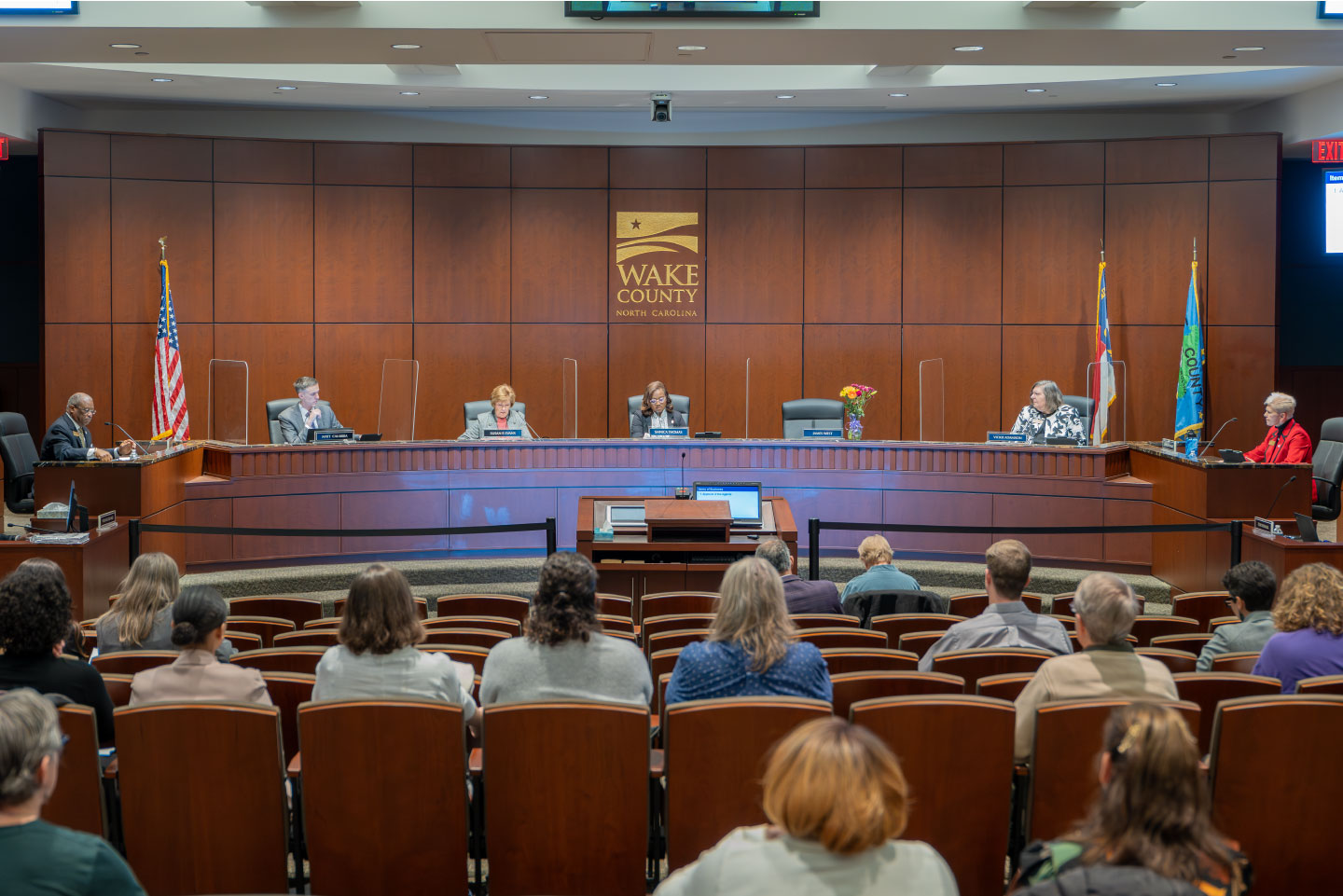
Members of the Wake County Board of Commissioners’ Affordable Housing Committee met Monday morning to review programs aimed at expanding affordable housing and addressing homelessness, including new funding initiatives, partnerships and ongoing planning efforts as the county continues to face rising housing costs and a growing population.
The meeting focused on the work of the Wake County Continuum of Care (CoC), a collaborative network that coordinates housing and services for people experiencing homelessness. It works with county departments, municipalities, and nonprofit partners to connect residents with housing and support services.
Commissioners also shared positive updates about individuals who have been able to move from homelessness into short- or long-term housing through county programs.
A major initiative discussed during the meeting was the Wake County Housing Opportunity Fund, supported by a new $10 million investment. The fund is a 2026 initiative designed to finance affordable housing development, including site acquisition and gap financing for low-income residents. Officials said the program works alongside the county’s Bridge to Home program, which uses $10.5 million to provide services such as housing navigation, financial assistance, and case management.
Bridge to Home is specifically targeted at people experiencing homelessness and offers services such as rental assistance, case management, and connections to healthcare resources.
County officials said emergency services for people without housing are coordinated through the Wake County Continuum of Care, which works with shelters and street outreach teams across the region. Residents who are at risk of losing housing are encouraged to contact Wake Prevent, a program focused on early intervention and prevention. For individuals already experiencing homelessness, officials recommend connecting with Oak City Cares or other partner organizations. Many of the county’s nonprofit partners like Triangle Family Services, are trained to conduct initial assessments and help people access services through the CoC system.
County leaders said they are also working toward a simpler system for people seeking help. Officials discussed plans to develop a single online platform where residents could easily find information about available programs and services.
Commissioner Vickie Adamson said having too many disconnected options can make it harder for people to get help and may lead to confusion or misinformation.
“If we can have one entry point, and let the community know, we’ll be able to help more people,” Adamson said.
Governance of the homeless response system is handled by the Wake County Continuum of Care Governing Board, the lead decision-making and policy-setting body focused on ending homelessness in Wake County. The board coordinates resources, sets strategic priorities, and oversees funding for local housing and service programs while emphasizing a trauma-informed and equitable approach to services.
Officials emphasized the importance of broad representation within the governance structure.
“It’s important to have municipalities represented (on the CoC governance board), but especially the municipalities that may not have housing departments so they can learn and grow, and have input,” said Commissioner Shinicia Thomas.
Commissioners also discussed the role that community organizations and faith groups can play in helping address homelessness.
“I know a lot of churches and religious organizations do a lot of work in our community. How can they get involved in helping their neighbors in this housing initiative for the unsheltered and homeless?” Commissioner Tara S. Waters asked during the meeting.
County officials said faith-based organizations can participate in the Continuum of Care as member organizations and help by volunteering, providing meals, and continuing their own outreach initiatives that connect people with services.
“Faith-based organizations certainly have a place at the table as CoC member organizations,” said Deputy County Manager Duane Holder, who oversees Wake County’s consolidated Health and Human Services agency.
Officials also reviewed the core operational systems that support the county’s homelessness response. These include the Homeless Management Information System (HMIS), which tracks data on housing services and outcomes and recently completed federal fiscal year 2025 reporting.
Despite those efforts, county data show that approximately 3,400 households are new or returning to homelessness each year. About 92 percent of individuals use shelters for an average of 38 days, and roughly 36 percent of those who exit the system return within six months. Officials estimated that about $24,000 per year is required to end homelessness for one household through housing and support services.
Officials said additional resources will be needed to meet the growing need through targeted investments. Planning for the new housing initiatives will continue over the coming months. County leaders outlined a timeline that included community outreach in February, public comment on a draft plan in March, with a final review and governance vote in April and continued program design and implementation through May of this year. Officials expect a formal launch and rehousing efforts to begin in July.
Earlier this week, Congresswoman Deborah Ross announced $850,000 in federal funding to renovate Second Street Place, a Wake County shelter serving people experiencing homelessness. The shelter, operated by The Bryant Center, will receive accessibility upgrades, showers, and other improvements as part of a broader $13 million package Ross secured for 15 projects across the county. The 98-bed facility connects guests with case management and services aimed at helping them move toward permanent housing.
“These funds help transform a building into something more important—a place of stability, a space that is safe and a place that provides opportunity,” said Vance Haywood, executive director of the Bryant Center.
Local leaders say the challenge is intensified by Wake County’s rapid population growth.
“Our county is at 1.2 million people. We’ve got six people moving in every day, and 25 kids being born every day. This isn’t just a city of Raleigh concern—we work with 11 other municipalities, and we appreciate Congresswoman Ross for helping bring this forward,” said Don Mial, chair of the Wake County Board of Commissioners.
U.S. Department of Housing and Urban Development data shows homelessness increasing in many communities across the country. Wake County has experienced a similar rise. The county’s most recent point-in-time count identified about 1,258 people experiencing homelessness, roughly 27 percent more than the previous year.
