
By Jheri Hardaway
Staff Writer
Raleigh - In a powerful event for Black History Month, the Capital City Lawyers Association (CCLA) collaborated with the City of Raleigh Museum to host "Civil Rights Talk" on Wednesday, February 18, 2026. The evening, led by CCLA President Taylor Scruggs-Smith, featured attorney Lex Jordan, Esq., who used a compelling architectural metaphor to challenge the audience's understanding of freedom and civil rights in America.
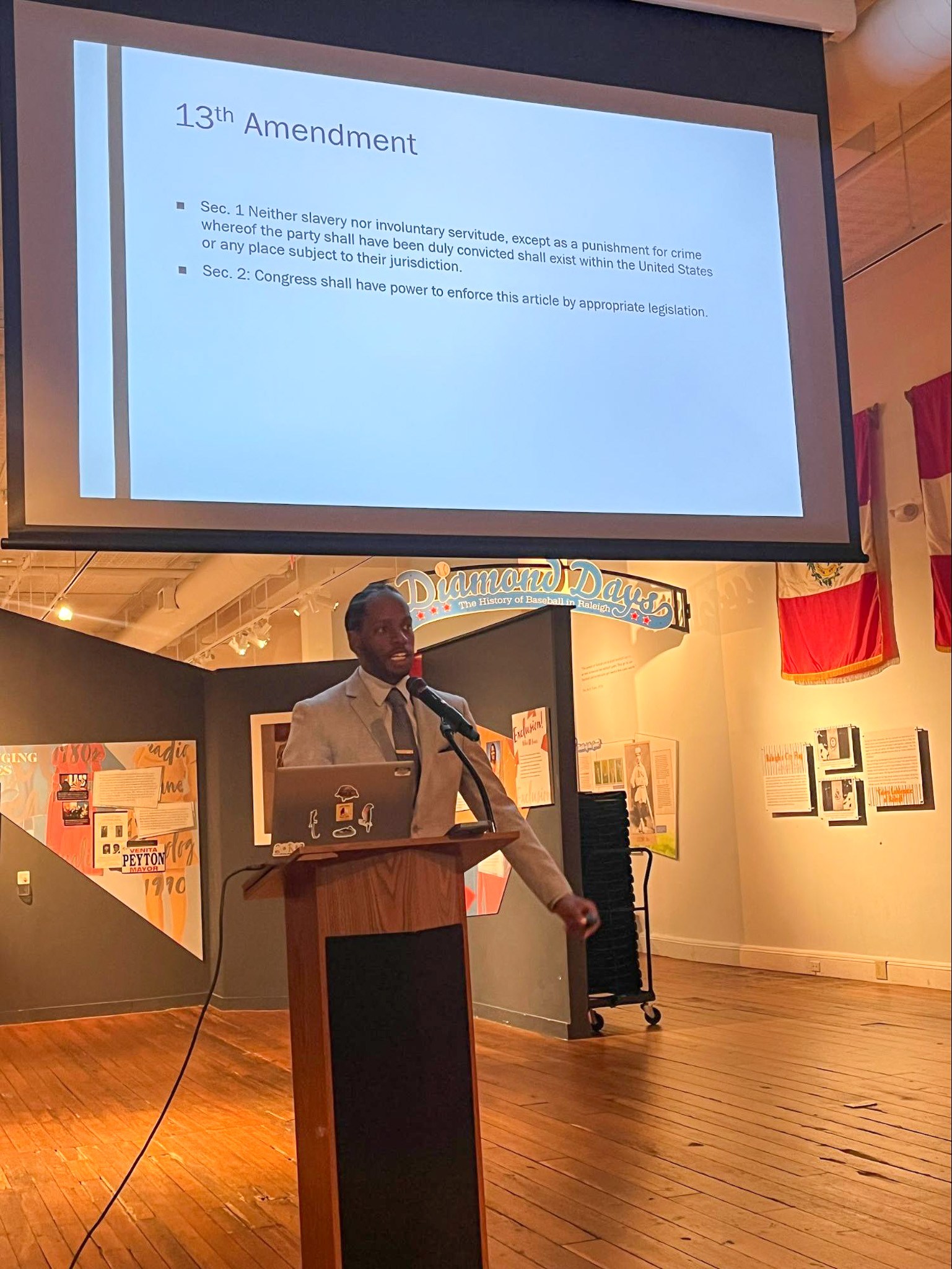 Jordan’s talk, titled “Building the ‘House of Freedom’,” centered on a core metaphor: the United States as a “House of Freedom.” While acknowledging the “stained glass windows” and “marble countertops” built on the labor and intelligence of African Americans, Jordan critically noted that the house still “lacks a roof.” The problem, he argued, is that without a roof, when political or social storms come, the people inside still feel the “intensity of the rains.”
His mission for the audience was clear: to finish the house by gaining “vision and understanding” of the legal foundation—the Constitution—to both protect past achievements and secure future ones. Jordan dove into a critical analysis of the Reconstruction Amendments, referring to that post-Civil War era as a historical "blip" where African Americans became "on paper free." He cautioned that these laws were often riddled with “loophole” natures.
The speaker drew direct lines from these historical precedents to contemporary legal battles, offering a sobering warning that “ignorance is slavery” and that knowledge is the only defense against the “removal of bricks” from the civil rights foundation.
Key legal challenges highlighted included:
Birthright Citizenship: Jordan addressed current threats to the 14th Amendment, arguing its original intent was to grant citizenship to first-generation Americans whose parents were trafficked and owed no “immediate allegiance” to the U.S.
Affirmative Action: He discussed the significant shift from the Bakke ruling to the 2023 Students for Fair Admissions v. Harvard ruling, noting a concerning trend where the Equal Protection Clause is now being “inverted” to strike down race-conscious admissions policies.
The NC Connection: Jordan brought the issue close to home by recounting the 1898 Wilmington Massacre. He described this historical trauma as a moment where “white supremacy branded itself” onto North Carolina, effectively erasing Black economic and political gains for nearly a century.
The Road from Law to Reality
Moving beyond the de jure (legal code) to the de facto (reality), Jordan emphasized that the legal rights of other marginalized groups—including the LGBTQ+ community and those fighting for women’s reproductive rights—often find their legal “roots” in the Black struggle for the 14th Amendment.
He concluded with a powerful motivational message, encouraging the audience to "keep hope alive," referencing Jesse Jackson. Jordan asserted that while the “house” is currently roofless, the “architects”—African Americans—have the power and the history to finish the build.
The City of Raleigh Museum, which is establishing itself as a cultural hub for conversations that challenge conventional thinking under the leadership of Abby Kellerman City of Raleigh Museum Director, continues to partner with organizations like the CCLA to host outstanding and informative programs that are unique to the city.
