
By Jordan Meadows
Staff Writer
Parker David Robbins emerged from the rigid racial order of antebellum North Carolina to become one of the most prominent Black public figures the state produced during and after the Civil War.
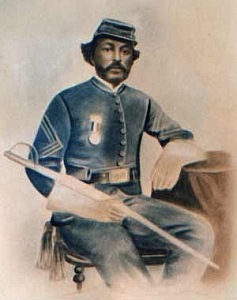 Born around 1834 in Bertie County, Robbins was a free person of color of mixed African and Native American ancestry. At a time when North Carolina law prohibited the education of Black people, Robbins was nevertheless literate, apparently educated through private means. By 1860 he stood out among more than 30,000 free Black North Carolinians as a landowner, holding a 102-acre farm, and as a skilled carpenter and mechanic who supported himself through his trade.
The outbreak of the Civil War opened a new path. In 1863, as federal authorities began recruiting African Americans into the United States Colored Troops, Robbins traveled to Norfolk and Fort Monroe, Virginia, because North Carolina offered no mounted Black units. On January 1, 1864, he and his younger brother Augustus enlisted in the 2nd United States Colored Cavalry Regiment.
Black soldiers were barred from commissioned officer ranks, with sergeant major representing the highest position available, yet Robbins advanced from private to sergeant major in just ten days. His rapid promotion reflected both his leadership and his reputation as a respected mechanic. He became one of only a handful of North Carolinians of color to reach that rank during the war, while Augustus also advanced, eventually serving as quartermaster sergeant of the regiment.
Robbins remained with the 2nd U.S. Colored Cavalry through the remainder of the conflict, taking part in operations across southeastern Virginia and northeastern North Carolina. When the fighting ended, the regiment stayed in federal service and was sent to the U.S.–Mexico border, where American troops monitored the French intervention in Mexico. Robbins’s military service concluded in Texas in February 1866, when the unit was officially discharged, and he returned home, having spent nearly three years in uniform and later receiving a federal pension for that service.
Back in Bertie County, Robbins moved quickly into public life during Reconstruction. In 1868 he was selected as a delegate to North Carolina’s constitutional convention, one of fifteen Black men chosen to help rewrite the state’s governing document. That same year county voters elected him to the North Carolina House of Representatives, where he served during the 1869–1870 sessions, and he was elected again for the 1870–1872 legislature.
Among North Carolinians who served in the United States Colored Troops, Robbins ranked among the highest to hold state office.
Following his legislative service, Robbins relocated to Hertford County, where he was appointed postmaster of the town of Harrellsville. His career then took another turn in 1877, as Reconstruction waned, when he resigned that post and moved to Duplin County. There he expanded his activities as a businessman and builder, owning and operating a sawmill and cotton gin and constructing homes in the community of Magnolia. He also built and piloted the steamboat Saint Peter, running it for years along the Northeast Cape Fear River and linking rural communities to regional markets.
Drawing on his background as a mechanic, he secured United States patents in the mid-1870s for a cotton cultivator and for saw-sharpening machinery, adding him to the small number of African American patentees of the era. He remained active in local Union veterans’ organizations while continuing his business ventures in Duplin County, where he lived for roughly four decades.
Robbins died in Magnolia on November 1, 1917, and was buried in Duplin County. Long after his death, his likeness became widely circulated, and his life story entered textbooks and museum exhibits as interest in Black history expanded in the late twentieth century. In recent years, residents of Duplin County have worked to secure broader state and national recognition for a man whose life connected military service, political leadership, entrepreneurship, and invention.
