
Carolina Public Press – Disagreements have always existed over early voting sites in North Carolina, no matter who is in power. County election board members regularly debate over whether to allow Sunday early voting, how many sites to use, where they should be located and how long they should be open.
But in Jackson and Guilford counties, Democratic board members are raising concerns over the exclusion of early voting sites that serve college students from 2026 primary election plans.
In Jackson County, Republican board members voted against Democratic board members to remove an early voting site from Western Carolina University’s campus. In Guilford County, Republicans denied Democrats’ request to add early voting sites on North Carolina Agricultural & Technical State University and University of North Carolina-Greensboro’s campuses.
In Cumberland County, Democratic and Republican board members agree about the inclusion of a site across the street from Fayetteville State University, but one Democratic member wants to remove another site next to a community college in a wealthy part of town to make room for a site in the northernmost part of the county.
So far, at least 65 counties have submitted their 2026 primary early voting plans to the State Board of Elections, according to spokesperson Jason Tyson. Sixty had unanimous approval, meaning that they’re essentially good to go. Five were not, which gives the State Board the final say. County boards have until Dec. 19 to send their plans to the state board.
Tyson said he expects the board to take up the non-unanimous plans during one of the first meetings of 2026.
Placing early voting sites on college campuses is popular; according to a recent survey commissioned by Common Cause, 79% of voters support locating early voting sites at locations accessible to student voters, including on campus. Younger voters and Democrats support campus early voting sites at higher levels.
Among some Republicans, there’s a perception that helping student voters is synonymous with helping Democrats.
As county boards now have Republican majorities, the question for election watchers is whether the exclusion of primary early voting sites located on or close to campus is part of business as usual or an emerging pattern driven by politics.
Jackson County and WCU
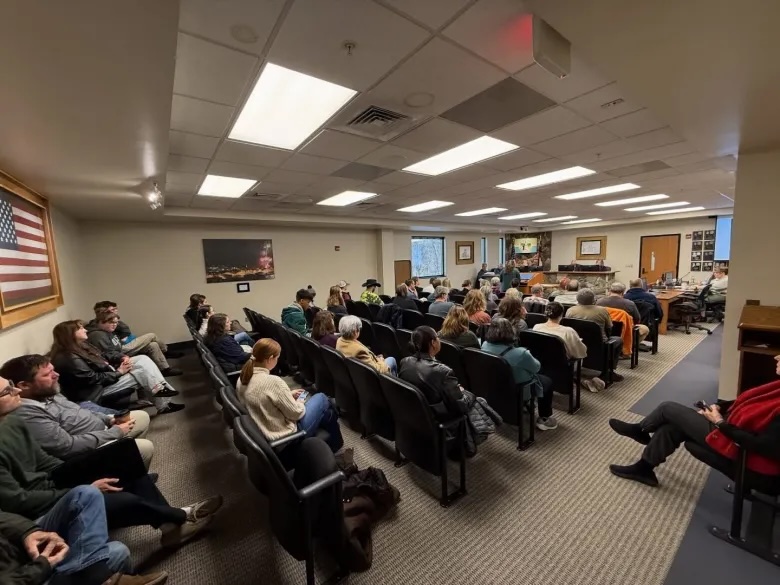
Zach Powell left Jackson County’s Dec. 9 election board meeting disappointed.
Powell, president of the Western Carolina University College Democrats, heard that the board might remove the WCU early voting site a few weeks ago.
Republicans claimed that the site wasn’t accessible, lacked ample parking and was intimidating to the broader community, Powell said. Board Chair Bill Thompson also implied that the university wasn’t politically neutral, he added.
“I’m not really sure where the chair is coming from,” he said.
The university hosts many community events for both students and the broader community, for one. While there may not be a ton of parking as it stands, the university was willing to reserve additional spots to make the site work, Powell explained.
“I definitely think that some of them, probably they have preconceived notions about college students and the way that they vote that aren’t necessarily reflective of the reality in Jackson County, on WCU’s campus, because Republicans and Democrat students use the polling site at roughly the same rate,” he said.
WCU is unique in another aspect: it’s taken the top spot for early voting sites with the highest proportion of same-day registrations in eight of the nine past elections, according to an analysis by Chris Cooper, WCU political science professor.
Undeniably, the site has increased youth early voting turnout since it began being used in 2016 for primary and general elections, he found.
Board members also brought up finances. They said they would save money by removing the WCU site. But Powell isn’t buying it. If they’re able to transport students to the nearest site, the Cullowhee Recreation Center, then that site will inherit the large volume of same-day registrants and student voters.
“The chair, Bill Thompson, claims that they’ll save $20,000 by closing the WCU site,” Powell said. “I’m not really sure where that number comes from. When you account for the labor and the infrastructure that will be needed, I think they’ll actually save a lot less than that.”
There’s a lot of handwringing about students helping Democrats win elections, but that’s not the full story. Sure, college students tend to lean more liberal, but there are plenty of Republican students too, and actually, many are registered unaffiliated now, Cooper said.
Students have a stake in the local and state government, even if they are temporary residents, Powell said.
“They live there, they learn there, they work there,” he said. “In a lot of cases, they contribute to the local economy. They’re there for more than half of the year, and there are decisions made at the state, local and federal level that affect college students.”
Cumberland County and Fayetteville St.
In Cumberland County, one Democratic board member wants to switch things up.
Election board members decided not to use the county board of elections office as an early voting site for next year’s primary election. So, they had to designate a replacement site fairly close to the office.
Republicans wanted to use Kiwanis Recreation Center, which is located close to a community college and has historically been used.
Irene Grimes, a Democratic board member, wanted to use the Smith Recreation Center, located across the street from Fayetteville State University, a historically Black university.
The board did not agree on a plan, but several proposals are out there. Both the majority and minority plan include the site across from Fayetteville State University. A plan brought up by the director, but quickly dismissed by board members, would have eliminated that site, Republican board chair Linda DeVore said.
Grimes and the other Democratic member want to exclude Kiwanis Recreation Center to make room for a Spring Lake site in the northernmost part of the county, since the county only uses seven sites normally. That would mean the Smith Recreation Center would replace the Kiwanis Recreation Center as the county board office replacement site. That’s never been the case before.
Since the early voting plan was not unanimous, the State Board will have the final say on the various proposals. They could also go with their own proposal.
While both the Smith Recreation Center and Kiwanis Recreation Center are close to colleges, Grimes said there’s more nuance than that. The Kiwanis Recreation Center is in the second-wealthiest neighborhood in Fayetteville, while the Smith Recreation Center is in the poorest neighborhood.
The two sites are 2.6 miles apart; Grimes previously argued that there was no need for two early voting sites so close together when there are only so many sites they can open. While the community college is a commuter school, which means students are able to drive to another site, not all FSU students can say the same, Grimes said.
Despite the director’s plan not gaining traction, Grimes felt like the board tried to “horse trade Smith away” during the discussion. She’s not confident in its future.
“Maybe I’m a little late to the party, but I have sensed this desire, move, whatever to strategically place early voting sites where it is politically convenient,” she said. “And that’s not how we should be doing elections.”
Guilford Co. rejects some early
voting sites
Guilford County Board of Elections Chairman Eugene Lester III started the Nov. 18 meeting with a statement. In the United States, he said, citizens have rights and privileges.
The right to be presumed innocent at trial, for example, is automatic, he said. But that’s not the case with privileges.
“Voting is a privilege,” Lester said. “Voting requires the citizens to actually take some action, to do some things, to discharge a duty, and it may require some work on the citizens’ parts.”
That’s when Democratic board member Carolyn Bunker decided to go through with her plan: to suggest adding North Carolina A&T and UNC-Greensboro early voting sites to the 2026 primary plan, she told Carolina Public Press.
While the county has used these sites for early voting during presidential years, the election board has never approved their use for midterm primary elections.
Specifically, Guilford County has used a North Carolina A&T early voting site for presidential general elections since 2004, and a UNC-Greensboro site since 2012, according to data from elections director Charlie Collicut. Both campus sites have been used for presidential primary elections since 2020. But they have never been selected for midterm elections.
So, while the sites were excluded from the 2026 early voting plan, it’s not quite accurate to say they were removed, Collicut said.
Nonetheless, Bunker feels like the board ignored East Greensboro and south High Point with their site selection.
She also suggested the addition of Barber Park and Washington Terrace sites, which are located in lower socioeconomic neighborhoods. The majority rejected the idea.
“The bottom line is, I think that they are trying to disenfranchise a certain part of the population — two parts of the population, the poor and the students,” she said.
In the 2024 general election, the NC A&T and UNC-Greensboro sites had the lowest early voting turnout of all sites, with about 750 voters each. It’s a big expense, Bunker said, but one she thinks is worth it to increase youth voter turnout.
While some early voting sites particularly accessible to students will likely not be available in the 2026 primary — pending the state board’s decisions — some turned out quite alright in county board discussions.
In Pitt County, there’s an approved site at Eastern Carolina University. In Wake County, North Carolina State University gets a polling location. Watauga County’s Appalachian State University site will stay in place, as will Orange County’s UNC-Chapel Hill location.
Cooper said it’s hard to say whether this will become a pattern, or what the state board will do.
“We’re just making a decision about one election,” Cooper said. “It is possible, certainly, that they can go back on any of this in a general election.”
